Last checked against official sources on 19 October 2026.
This guide is general information, not legal, tax, financial or mechanical advice. Rules, rates and fees change, so confirm the details with the official sources listed at the end before you act. CarQnA is not affiliated with any of them.
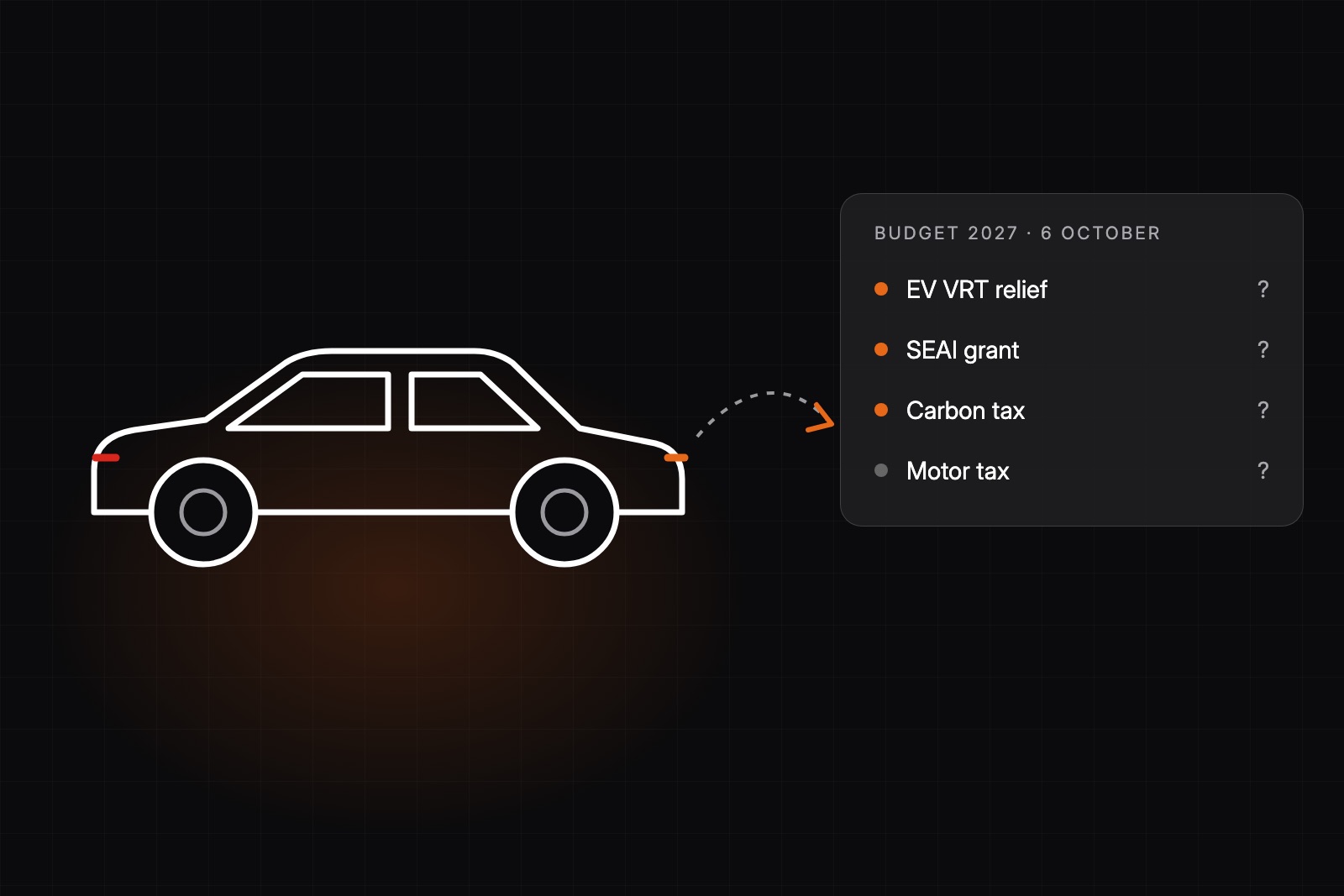
Budget 2027 was presented on Tuesday 6 October 2026. For car buyers, three things changed: the VRT relief on electric cars now runs to the end of 2028, VRT goes up on cars above 80 g/km of CO2 from 1 January 2027, and the next carbon tax rise on petrol and diesel is pushed back to 1 May 2027. Every figure below comes from the official budget documents.
The quick summary
- EV VRT relief of up to €5,000 is extended to 31 December 2028. It was due to end on 31 December 2026.
- From 1 January 2027, VRT rates for bands 3 to 20 (cars over 80 g/km of CO2) go up by 1%. Bands 1 and 2 do not change.
- Carbon tax on petrol and diesel stays at €71 a tonne until 1 May 2027, then rises to €78.50 a tonne. A further rise follows on 13 October 2027.
- The temporary cut in petrol and diesel excise is extended to 28 February 2027, then restored in steps by 30 June 2027.
- No new SEAI grant amount, no scrappage scheme and no motor tax change were announced.
1. VRT relief on electric cars: extended to the end of 2028
Battery electric cars get up to €5,000 off Vehicle Registration Tax. Budget 2027 extends this relief for two more years, to 31 December 2028. Before the budget it was due to end on 31 December 2026, so there is no longer a rush to register an electric car before the new year. Like every budget measure, the extension becomes law through the Finance Bill, which is normally passed before Christmas, so Revenue's own electric vehicles page still shows the old 31 December 2026 date for now.
The budget documents announce no change to how the relief works. Today the full €5,000 applies where Revenue values the car (its OMSP) at €40,000 or less, and it tapers to nothing at €50,000.
2. VRT goes up on petrol and diesel cars from 2027
From 1 January 2027, the VRT rates for bands 3 to 20 go up by 1%. These are the bands for cars with CO2 emissions of more than 80 g/km, which covers almost every petrol and diesel car. Bands 1 and 2 (80 g/km or less) stay the same, so electric cars are not affected.
There is no new weight-based VRT surcharge. The budget documents do not list the new rate for each band, so our VRT guide shows the rates that apply in 2026.
3. Fuel: carbon tax and excise
Carbon tax on petrol and diesel was due to rise from €71 to €78.50 a tonne on 14 October 2026. That rise is deferred to 1 May 2027. A further rise takes place on 13 October 2027, which puts petrol and diesel back on the path to €100 a tonne set out in the Finance Act 2020.
The temporary cut in petrol and diesel excise, which the Minister said was in place until November, now stays fully in place until 28 February 2027. Excise then goes back up in steps on 28 February, 8 April, 1 May and 30 June 2027, when it is fully restored. The Minister said there will be no tax increase at the pump this winter.
4. The SEAI grant and scrappage
The budget documents do not set a new SEAI grant amount or price cap. The Expenditure Report says the existing vehicle grants for low emission vehicles continue in 2027. Today the grant takes up to €3,500 off a new battery electric car, and the car's price must be €50,000 or less. Check seai.ie for any change to the grant.
No new scrappage scheme was announced. The €5,000 ICE2EV pilot, which opened and closed on 1 July 2026, remains under review by the Department of Transport and SEAI.
5. Motor tax and company cars
Budget 2027 makes no change to motor tax, so a fully electric car still pays €120 a year and petrol and diesel cars pay by CO2 band. The budget documents also announce no change to benefit in kind on electric company cars.
Should you wait or buy now?
If you are buying an electric car, the VRT relief now runs to the end of 2028, so you do not need to rush to register before 31 December 2026. If you are buying a petrol or diesel car above 80 g/km, registering it before 1 January 2027 avoids the 1% VRT rise. For fuel, prices at the pump should not see a tax rise until 28 February 2027.
Common questions
When was Budget 2027 announced?
On Tuesday 6 October 2026. The Minister for Finance, Simon Harris, set out the tax measures in the Dáil.
Was the VRT relief on electric cars extended?
Yes. Budget 2027 extends the VRT relief of up to €5,000 on electric cars to 31 December 2028. It was due to end on 31 December 2026.
Is VRT going up in Budget 2027?
Yes, for cars over 80 g/km of CO2. From 1 January 2027, the rates for VRT bands 3 to 20 go up by 1%. Bands 1 and 2 do not change.
Will petrol and diesel go up in Budget 2027?
Not this winter. Carbon tax stays at €71 a tonne until 1 May 2027, then rises to €78.50 a tonne, with a further rise on 13 October 2027. The temporary excise cut lasts until 28 February 2027 and is fully restored by 30 June 2027.
Is there a scrappage scheme in Budget 2027?
No. No new scrappage scheme was announced. The ICE2EV pilot from July 2026 remains under review.
Sources
- gov.ie: Budget 2027 Taxation Measures (Tax Policy Changes, Department of Finance)
- gov.ie: Statement by Minister Harris on Budget 2027
- gov.ie: Budget 2027 Expenditure Report
- Citizens Information: Budget 2027
- Revenue: VRT on electric vehicles
- SEAI: electric vehicle grant amounts
- Citizens Information: motor tax rates
- gov.ie: ICE2EV pilot scheme indicates strong consumer demand