Last checked against official sources on 19 October 2026.
This guide is general information, not legal, tax, financial or mechanical advice. Rules, rates and fees change, so confirm the details with the official sources listed at the end before you act. CarQnA is not affiliated with any of them.
Importing a used car from the UK can still save money, but the bill is bigger than the price you pay the seller. Vehicle Registration Tax (VRT), a NOx charge and, for cars from Great Britain, import VAT and possibly customs duty all have to be paid before the car can be registered here. This guide shows how each one is worked out in 2026 and the deadlines you need to hit.
The quick answer
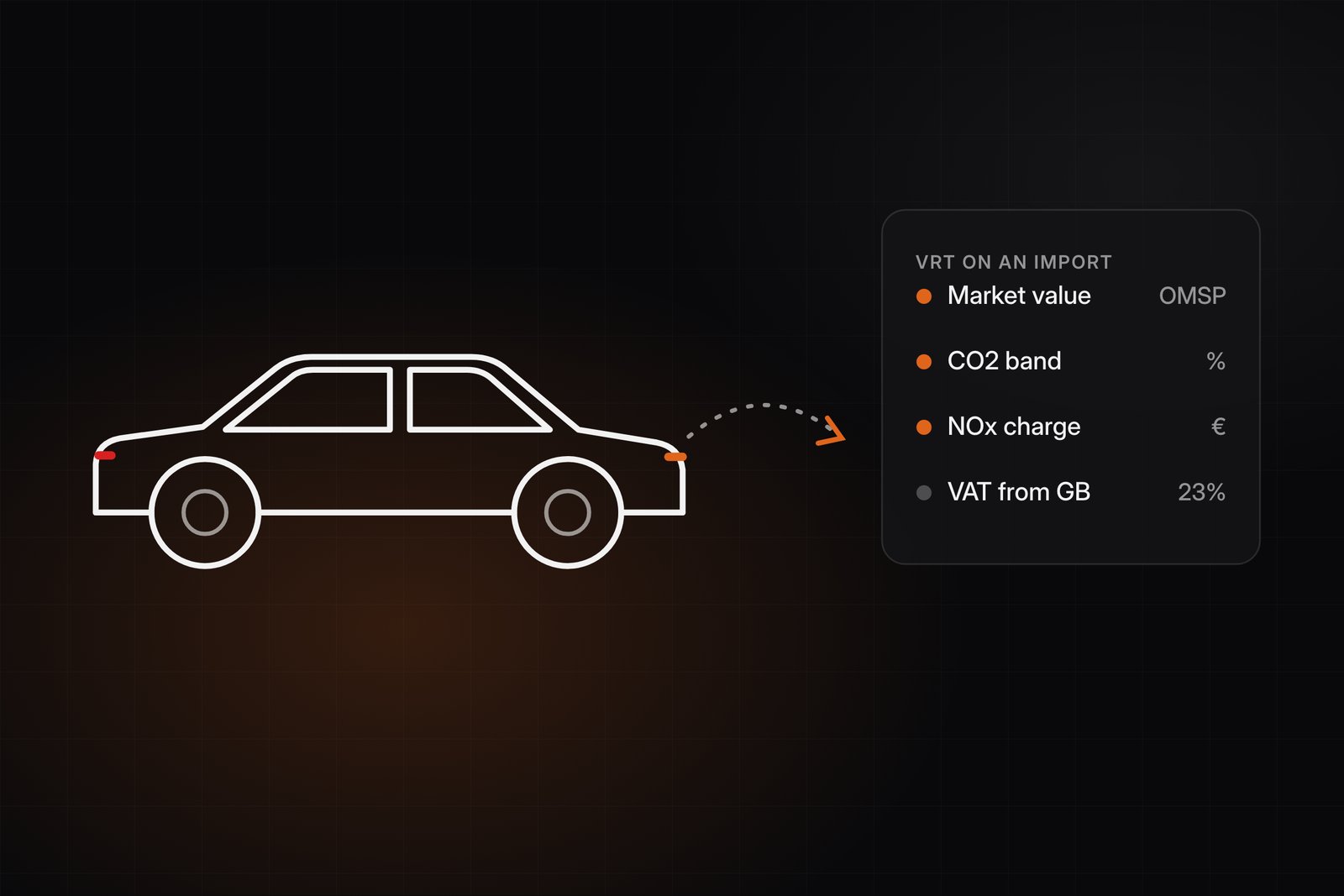
- VRT is a CO2 charge of 7% to 41% of Revenue's valuation of the car (the OMSP), plus a NOx charge.
- From Great Britain you also pay 23% import VAT, and 10% customs duty unless the car is of UK preferential origin.
- From Northern Ireland there is normally no VAT or duty, if you can prove the car was in Northern Ireland.
- Book a VRT appointment with the NCTS within 7 days of the car arriving, and register it within 30 days.
How VRT is calculated
It starts from the OMSP, not what you paid
Revenue charges VRT on the Open Market Selling Price (OMSP): its estimate of what the car would sell for in Ireland, including VAT and VRT. That is usually more than you paid in the UK. Revenue's online VRT calculator gives you an estimate in advance, but the final figure is only fixed when the car is presented at the NCTS for registration.
The CO2 charge
The main part of VRT is a percentage of the OMSP, set by the car's CO2 emissions on the WLTP test. These are the rates for passenger cars registered since 1 January 2022:
- 0 to 50 g/km: 7%
- Over 50 to 80 g/km: 9%
- Over 80 to 85 g/km: 9.75%
- Over 85 to 90 g/km: 10.5%
- Over 90 to 95 g/km: 11.25%
- Over 95 to 100 g/km: 12%
- Over 100 to 105 g/km: 12.75%
- Over 105 to 110 g/km: 13.5%
- Over 110 to 115 g/km: 15.25%
- Over 115 to 120 g/km: 16%
- Over 120 to 125 g/km: 16.75%
- Over 125 to 130 g/km: 17.5%
- Over 130 to 135 g/km: 19.25%
- Over 135 to 140 g/km: 20%
- Over 140 to 145 g/km: 21.5%
- Over 145 to 150 g/km: 25%
- Over 150 to 155 g/km: 27.5%
- Over 155 to 170 g/km: 30%
- Over 170 to 190 g/km: 35%
- Over 190 g/km: 41%
Each band also has a minimum charge, from €140 in the lowest band to €820 in the highest. Budget 2027 raises the rates for bands 3 to 20 (over 80 g/km) by 1% from 1 January 2027. The rates above apply to cars registered in 2026.
Older cars with only an NEDC figure
Many older UK cars only show a CO2 figure from the earlier NEDC test. Revenue converts it to a WLTP equivalent before choosing the band: for a diesel, NEDC x 1.1405 + 12.858; for any other car, NEDC x 0.9227 + 34.554.
The NOx charge
On top of the CO2 charge comes a charge on nitrogen oxide emissions, in mg/km: €5 for each mg up to 40, €15 for each mg from 40 to 80, and €25 for each mg above 80. If you cannot show a NOx figure, Revenue applies a flat €4,850 to a diesel and €600 to any other car, so find the figure before you buy. It is on the Certificate of Conformity, and UK V5C logbooks issued before April 2019 may show it too.
A worked example
Say Revenue values a used petrol hatchback at €18,000, and it emits 118 g/km on WLTP and 20 mg/km of NOx. The CO2 charge is 16% of €18,000, which is €2,880. The NOx charge is 20 x €5, which is €100. VRT comes to about €2,980. These are example figures: your car's own OMSP and emissions decide the real amount.
From Great Britain: customs and VAT
Since Brexit, a car brought in from England, Scotland or Wales is an import from outside the EU. Before you can register it, you need a Customs Declaration, which gives you a Movement Reference Number (MRN).
- Import VAT at 23% is due on the customs value: the price, plus transport, plus any duty.
- Customs duty is 10%, or 0% if the car is of UK preferential origin and you have the paperwork to prove it.
- Returned Goods Relief can apply to a car that was previously in the EU and is coming back, if the conditions are met.
- A nearly new car (six months old or less, or 6,000 km or less) is a new means of transport, and VAT is payable on it.
From Northern Ireland
Cars brought in from Northern Ireland are normally free of customs duty and import VAT under the Windsor Framework, provided you can prove the car was in Northern Ireland. Proof can be a Northern Ireland import declaration, or an NI V5C together with the car's service and MOT history there. Without it, the car can be treated like a GB import.
Importing an electric car
Battery electric cars pay the lowest CO2 rate and also get VRT relief of up to €5,000 where the OMSP is €40,000 or less, tapering to nothing at €50,000. Budget 2027 extended the relief to electric cars registered before 31 December 2028.
Step by step
- If the car comes from GB, complete the Customs Declaration and keep the MRN.
- Book a VRT appointment with the NCTS within 7 days of the car arriving in Ireland.
- Register the car and pay VRT within 30 days of arrival.
- Bring the V5C, proof of purchase, a completed VRTVPD2 form, photo ID, proof of address, proof of your PPS number, the Customs Declaration for a GB car, and a Certificate of Conformity or other NOx evidence.
- Put Irish registration plates on the car within 3 days of registering it.
After registration
Tax the car on motortax.ie and have Irish insurance in place before you drive it. Its first NCT is due four years after it was first registered anywhere, then on the normal schedule.
Is it still worth importing?
It depends on the car. Add VRT, the NOx charge, and for a GB car 23% VAT, any duty and transport, then compare the total with the same car for sale here. Revenue's VRT calculator gives you a starting estimate for a specific car.
Common questions
How much VRT will I pay on a UK import?
It depends on Revenue's valuation of the car (the OMSP) and its emissions. The CO2 charge is 7% to 41% of the OMSP, plus a NOx charge. Revenue's online calculator gives an estimate; the final figure is set when you register the car.
Do I pay VAT on a used car from the UK?
From Great Britain, yes: 23% import VAT on the customs value. From Northern Ireland, normally not, if you can prove the car was there under the Windsor Framework.
How long do I have to register an imported car?
Book a VRT appointment with the NCTS within 7 days of the car arriving, and register it within 30 days.
Is there VRT relief on an imported electric car?
Yes. Battery electric cars get up to €5,000 off VRT where the OMSP is €40,000 or less, tapering to nothing at €50,000, for cars registered before 31 December 2028.
Sources
- Revenue: applying the VRT rates
- Revenue: calculating the NOx charge
- Revenue: how the OMSP is assessed
- Revenue: registering a vehicle from Great Britain
- Revenue: registering a vehicle from Northern Ireland
- Revenue: VRT on electric vehicles
- gov.ie: Budget 2027 Taxation Measures (Tax Policy Changes, Department of Finance)
- Citizens Information: importing a car into Ireland
- Citizens Information: Value Added Tax (VAT)